

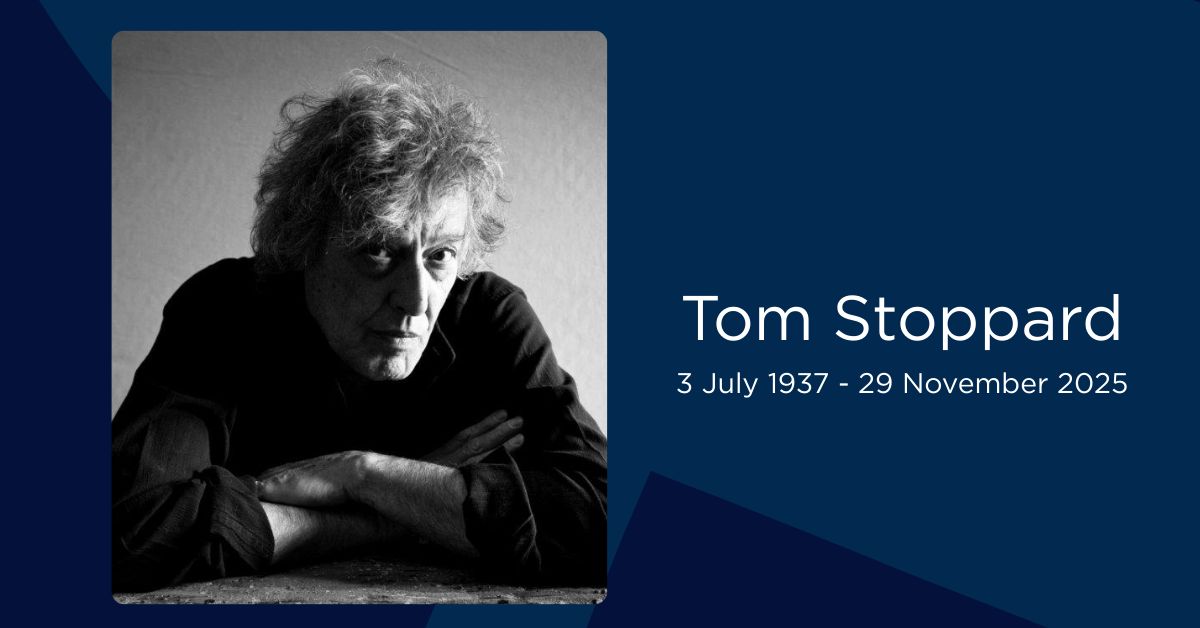
We were saddened to hear of the recent death of Sir Tom Stoppard, a much-loved member of the Society of Authors for over 50 years and a SoA lifelong Fellow.
A leading light of British theatre, his career spanned six decades, beginning with Rosencrantz and Guildenstern Are Dead, which premiered in 1966. His wit and art of language left an indelible mark on our stage and screen through work such as Arcadia, Jumpers and his Oscar-winning screenplay Shakespeare in Love.
At the very start of his career, in 1967, he wrote for The Author magazine on the uncertainty and false starts of the writing life. It is a joy to read for any writer 60 years later.
Referring to his early play “A Walk On The Water” in 1962
“Of course, another writer would not have waited that long. He would at least have revolted against the sheer inefficiency or the discourtesy of letting nine months go by without a yes, no, or maybe. But I was diffident about A Walk on the Water and, anyway, it was obvious to me that my name would be made by the one-acter as soon as someone read it …At the end of 1961 I sent the latter to an agent who liked it enough to ask if I had anything else to see…before the week was out I had been summoned to London amid great excitement. An option was bought immediately and drunk with riches (£100) i went out and bought books and a Picasso print.”
You can read the full article here.
Tributes and treasured memories have poured in from those who knew him.
Author and SoA Fellow Simon Brett told us,
‘I was doing the Oxford University late night revue on the Fringe of the Edinburgh Festival in 1966. Also being presented by the same company was a rather strange new play which few of us really understood, called Rosencrantz and Guildenstern are Dead. I was actually asked to play Hamlet in the show, but turned it down because in that play it’s not much of a part. I much preferred the idea of spending my early evenings watching other Fringe shows.
The playwright attended some of the rehearsals. A tall, thin, chain-smoking man, not much older than we were, but with much more style about him than any of us had. He was introduced as Tom Stoppard and, when the play became a huge international success, we all said we’d recognised its intrinsic merit right from the start.
From then on, I saw every play he wrote, dazzled by the acrobatics he could perform with the English language. As a crime writer, I particularly loved The Real Inspector Hound, such a nimble and hilarious send-up of the Golden Age whodunit.
I met him again when I was Chair of the Society of Authors and hosted a dinner for him at the Groucho Club after some awards ceremony. He was charming and witty as ever.
And his work has an enduring quality. Actual reality dates, but the work of writers who create their own parallel reality – like P.G. Wodehouse, Agatha Christie, Harold Pinter and Tom Stoppard – that will be with us for a long time. And our lives are all the richer for it.’
We shall leave Sir Tom with the last word.
“We cross our bridges when we come to them and burn them behind us, with nothing to show for our progress except a memory of the smell of smoke, and a presumption that once our eyes watered.”


Dear Simon Brett
I have just read your memories about Tom Stoppard. YOu may not remember me, I am/was an actress and now have become a writer. I would love to have a brief chat if you are available at any time? My neighbour worked with Tom Stoppard translating plays from Russian to English. Very best wishes Bridget McConnel.
It is always deeply moving, and a little sad, how often artists receive the fullest recognition only when they are no longer here to witness it. Although I didn’t know Tom Stoppard’s work as well as many do, I have great respect for the contribution he made to literature and to the world of ideas. As writers, we all contribute in different ways, and his voice clearly mattered to many. Moments like this remind me how important it is that we value authors, writers and their work while they are still with us – including the many good writers whose… Read more »
I saw Arcadia in an early production and loved it without ever fully understanding what was going on. As is generally known, this was not an unusual experience for audiences at Stoppard plays.
I also saw Leopoldstadt just before it closed in the first Covid lockdown, and not only comprehended everything but was deeply moved.
I’ve just booked tickets for the Old Vic restaging of Arcadia. I trust that Leopoldstadt will also see a revival in the not distant future.
Tom Stoppard was a Jewish immigrant who became more English than English. His mother had married a British officer and Tom was greatly influenced by him as well as his ownJewish values. Of course today Tom Stoppard`s brilliant work would have been boycotted by publishers and agents for fear of offending the antisemitic idiots.
Nonsense. Why play for such cheap political points from a great writer’s death? It’s precisely the sort of adversarial victim-play that breeds antisemitism.