

Artificial intelligence
We work to protect authors in an age of generative artificial intelligence (gen AI)
In this age of rapidly advancing technology, it is not feasible to oppose technology or take a stance that is ‘humans against the machine’. There are many ways that innovation in AI can contribute meaningfully to economic growth and public benefit, but this cannot be at the expense of creative human endeavour.
As such, we take a human-first approach to AI which considers both the variety of ways that creators might already be experimenting and using technology in their business practices, and the risks that unregulated, rapid roll-out of generative AI is having on the creative industries, society and the environment.
This is why we are calling on the UK Government to work with us to ensure that the tech industry acts in ways that safeguard the UK’s publishing industry, worth £11 billion, by respecting our primary copyright legislation (the Copyright Designs and Patents Act 1988).
The SoA actively campaigns against the unregulated practices of tech companies worldwide that have trained gen AI models on copyright-protected material without permission or compensation.
Training did not just happen on large volumes of anonymous content or data; millions of copyright-protected books were scraped and copied by US tech companies. This is why we can’t stand by whilst creators’ rights are being eroded for the sake of innovation.
The issue is three-fold:
1. Theft of creators’ works to train Gen AI foundational models
The Atlantic magazine investigation exposed how Meta used the pirate shadow library LibGen to train its large language model, Claude. They published a database in 2025 listing all the works that Meta had accessed, showing the global scale of this practice.
Since then, more details have come to light about the widespread use of copyright-protected works being used without a licence to train AI models, including in the high-profile Anthropic legal settlement.
We call for compensation for all authors and creators for the unauthorised use of their work. It is important to note that the SoA is not a rightsholder so we cannot take a case directly to UK courts, but we are doing all we can to support authors and the publishing industry through all the available legal channels.
2. Gen AI’s risk to author incomes and jobs displacement
Evidence shows Gen AI’s impact is already here:
- 57% of authors say their career is no longer sustainable due to the impact of Gen AI
- 26% of illustrators and 36% of literary translators report cancelled or redirected commissions in favour of Gen AI
- 72% of authors say job opportunities have already been cut due to Gen AI
- 43% of literary translators and 37% of SoA illustrators saw earnings fall because of Gen AI
- 65% of fiction and non-fiction writers expect further income decline; 77% of literary translators and 78% of SoA illustrators agree
- 86% of authors say Gen AI has already reduced their earnings
Further reading: SoA survey reveals a third of translators and quarter of illustrators losing work to AI – The Society of Authors
3. Market risk and crisis of confidence in authenticity
The rapid increase in AI-generated and ‘fake’ books undermine consumer confidence. Recent high-profile cases of AI-generated work being published and winning prizes demonstrate the need for transparency and clear labelling.
This is why we developed our Human Authored scheme which enables members to declare that their work has been created by a human, and not using generative AI.
Ultimately, we believe that the onus should be on tech companies to label AI-generated content, and we’ll continue to call for regulation to ensure there is full transparency so that consumers can makes informed buying choices and human creativity is protected.
We are clear that our own grants and prizes do not accept submissions that are generated using generative AI. We stand behind the principle that human creativity should be celebrated and protected with all its imperfections.
The change we want to see
Technologies available in the UK that output text, images or music (Generative AI – GAI) need to meet a simple set of regulations to protect creators. That’s why we have worked on the CLEAR Framework which offers a fair future for creators.
In January 2026, we called on government to set a global standard for ethical, human-centred AI through the CLEAR Framework:
C Consent first
L Licensing not scraping
E Ethical use of training data
A Accountability and transparency
R Remuneration and rights
How we campaign
We continue to work closely with industry and campaign partners, nationally and internationally. We feed into consultations, make policy recommendations and meet regularly with parliamentarians and government officials to share evidence.
Recent work
In 2024 the Government consulted on AI & Copyright. The SoA undertook research with members and responded to reject their opt-out model which would allow AI companies to train on copyright-protected work without permission or payment.
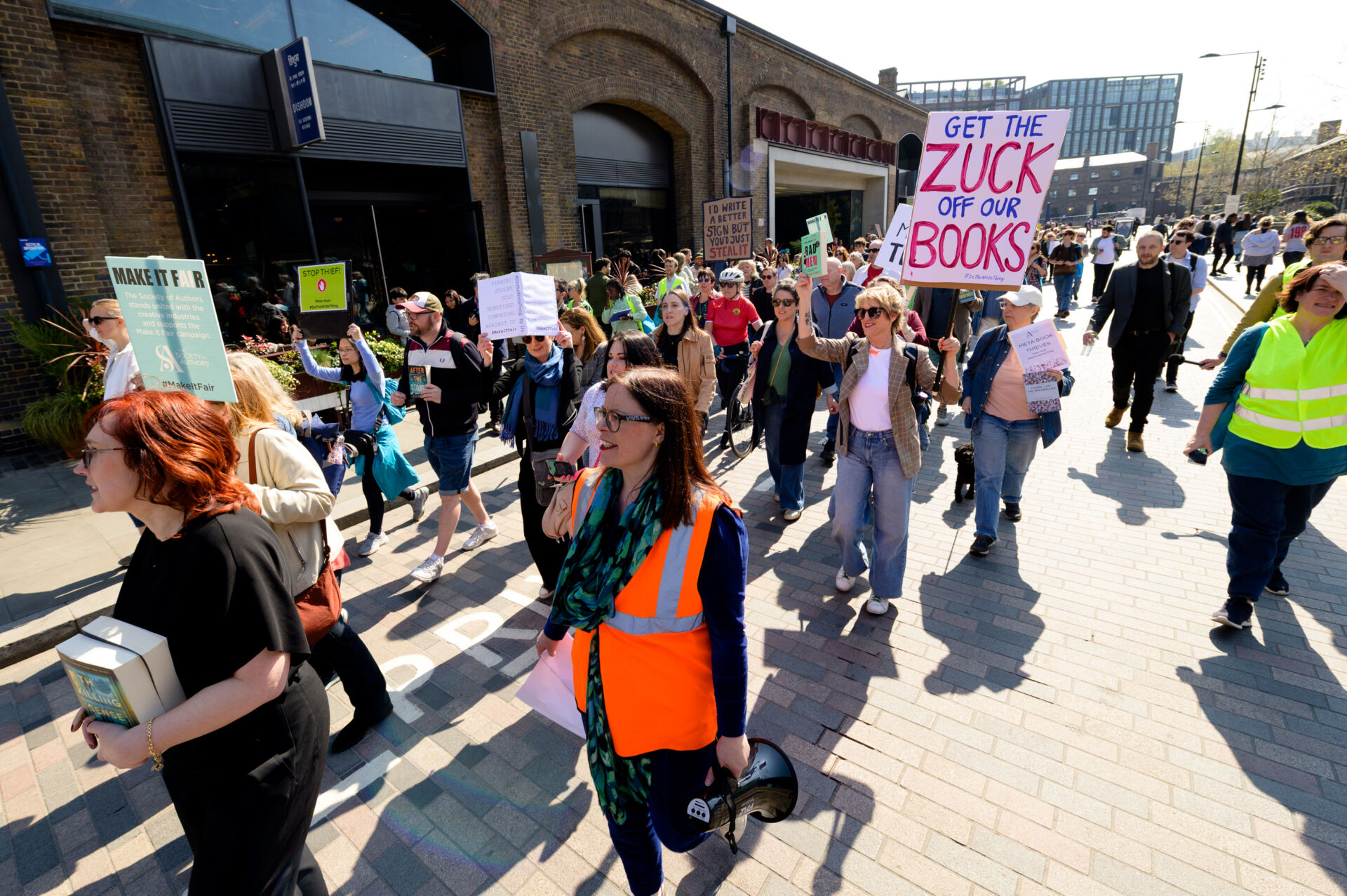
Organisations across the creative industries, including the Society of Authors (SoA), strongly opposed the opt-out approach and took part in the Make it Fair Campaign which achieved large scale support.
The SoA also held a protest at Meta HQ about the unauthorised use of pirated books to train their AI large language model.
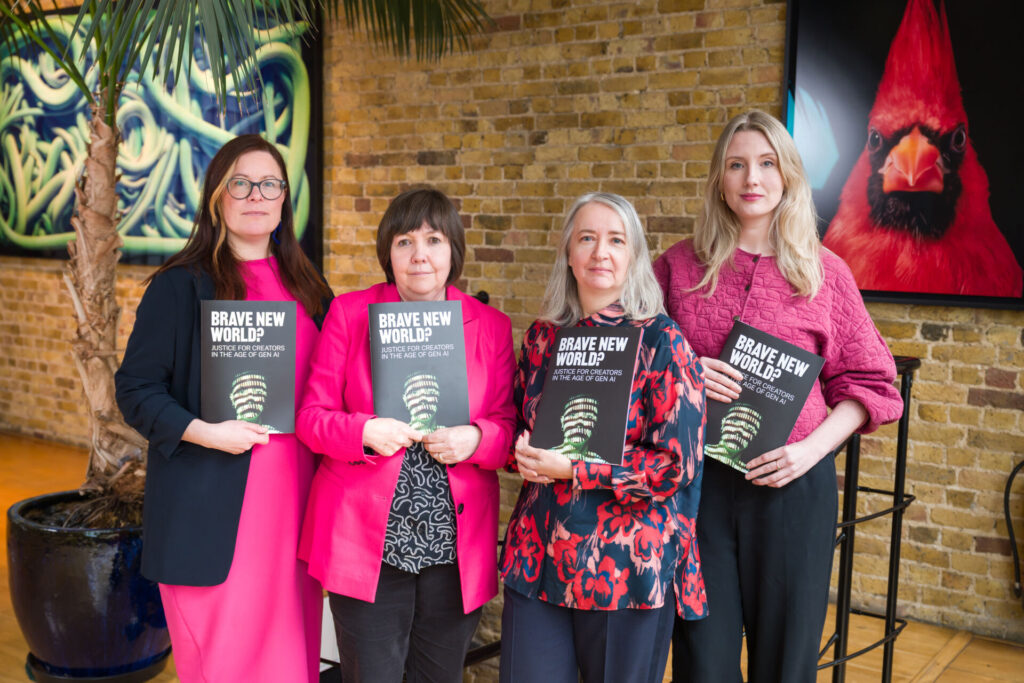
We partnered with members of the Creators’ Rights Alliance on a ground-breaking report: Brave New World? Justice for Creators in an age of Gen AI and we gave evidence at the Lords Digital and Communications Select Committee.
At London Book Fair 2026, we supported the Don’t Steal This Book campaign and we launched our Human Authored labelling scheme. On 18 March 2026, as outlined in the Data Use and Access Bill 2025, the Government had to report on their progress. In their statement, they confirmed Government no longer had a preferred option and they reset the framing of this work.
Whilst we are holding the line Government has neither offered an alternative solution nor ruled out any of the options. Instead, they set out four key areas for the next phase of its work in the areas of
- Digital replicas
- AI labelling
- Creator control
- Independent creatives
We welcome the opportunity to work with Government and we look forward to seeing this work develop in a meaningful and impactful way with direct input from authors and creators.
We have a once-in-a-lifetime opportunity to ensure that Gen AI works with human creativity, not against it. Join us in making this case.