

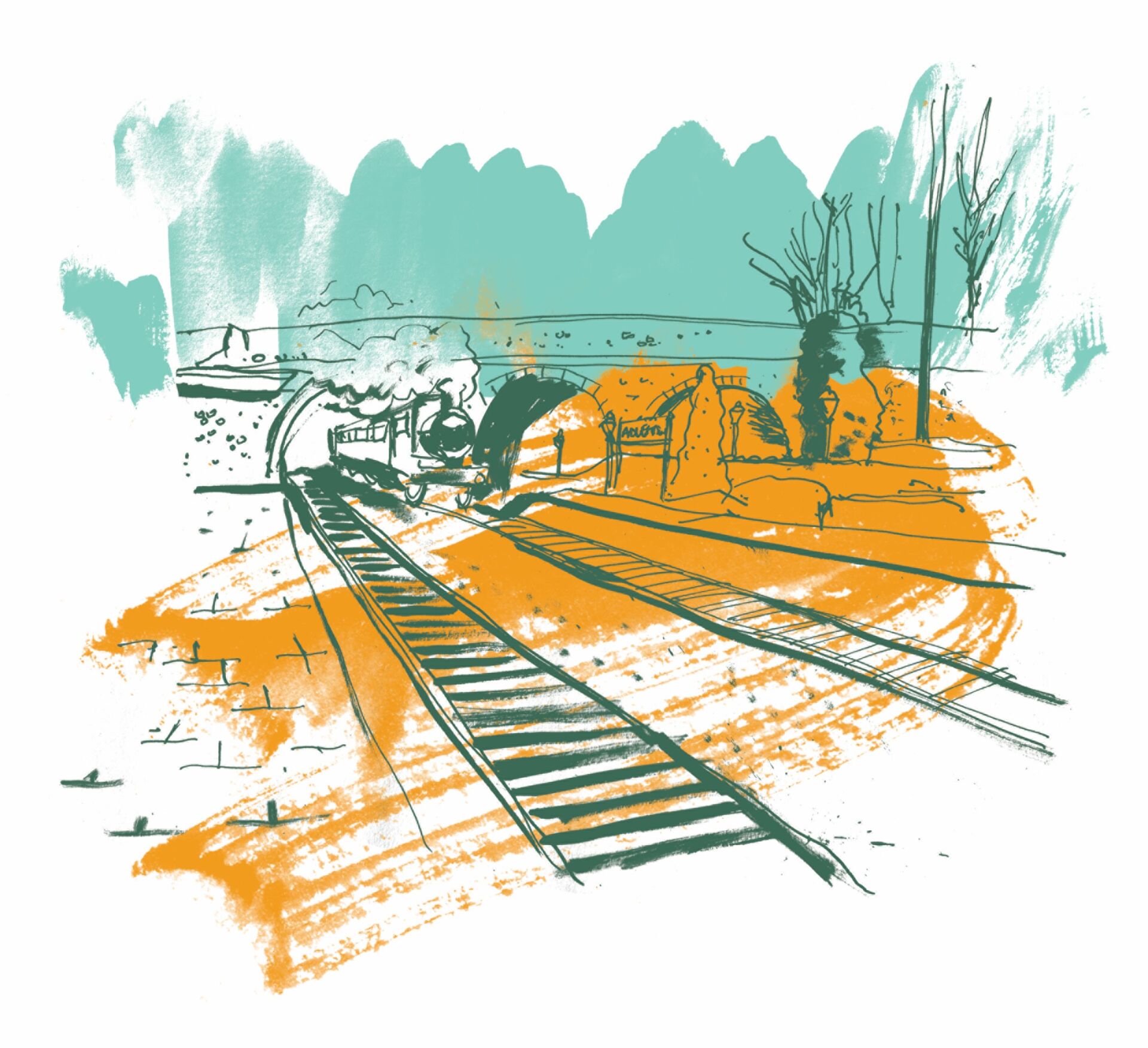
Just over a century ago, the poet Edward Thomas wrote an extraordinary poem about a train journey:
Yes. I remember Adlestrop—
The name, […]
Like Philip Larkin’s ‘Whitsun Weddings’ it notices what happens when a train stops:
because one afternoon
Of heat the express-train drew up there
Unwontedly. It was late June.
Part of the pleasure of reading ‘Adlestrop’ is that we are complicit in the making of the poem. ‘Willow-herb’ is visible from the train, so there may be hedges, the ‘cloudlets’ that appear need a blue sky, and if it’s June then it’s likely to be warm in that carriage.
The steam hissed. Someone cleared his throat.
No one left and no one came
On the bare platform.
But it’s the machine ‘hissing’ and the human ‘throat clearing’, that makes this poem seem, all these decades later, like a living thing. This is a poem by a poet who listens very closely.
A few months after writing ‘Adlestrop’, Thomas enlisted in the Artists Rifles regiment, taking the path that would lead him to the epoch-shattering machine noise of the First World War. But when the poet’s train stops ‘unwontedly’ in Gloucestershire, he is merely on the threshold of the machine world. The train becomes a frame for the countryside, a proscenium arch rather than an obstruction, and its passengers are given an unscheduled performance:
‘And for that minute a blackbird sang’.
‘Adlestrop’ takes about a minute to read – the length of the blackbird’s song in the poem, its content matching its form (as Michael Symmons Roberts told Radio 4 listeners this year). Its rhymes feel organic, never forced; they set each other off as birds do, in a chain of responses:
Close by, and round him, mistier,
Farther and farther, all the birds
Of Oxfordshire and Gloucestershire.
And that final rhyme of Thomas’s lets us feel, not just think mythically: land and sky meet, distances collapse, ‘mistier’ chimes with ‘farther’, ‘farther’, ‘Oxfordshire’ and ‘Gloucestershire’, each rhyme rippling out like the birdsong in the poem.
Thomas liked to listen for what might otherwise go unnoticed. He said of the chiffchaff’s arrival in a wet spring that ‘in the blasting or dripping weather which may ensue, the chiffchaff is probably unheard; but he is not silenced…I always expect him and I always hear him’. In his poem ‘The Unknown Bird’ only its speaker can hear the call of a mysterious species ‘as if the bird or I were in a dream’. Thomas knew, however, that in reality he was not a solitary listener, or a solitary observer of the natural world. He notes in his pamphlet ‘The Country’ that ‘several thousand volumes annually of verse up to the neck in the country’ were being produced for ‘villa residents and the more numerous others living “in London and on London”’ – nature books for readers, in other words, who were separated from rural life.
A similar estrangement, perhaps, underwrites the recent surge of interest in listening – a sense that we are losing a certain quality of attention, as well as the opportunity to practise it. There are books on listening for business leaders, couples and parents, as well as books on how to listen to the more-than-human world. In Thomas’s time there were no podcasts or mobiles to break the solitude of a walk, and much less mechanical noise for birds and other animals to compete with. Today we can feel like sound absorbers rather than listeners, and our reaction, ironically, may be to shield ourselves further from natural sounds and natural silences with the aid of headphones. As the psychoanalyst Adam Phillips writes, ‘Learning to listen can only be learning – if that is the right word – to bear what listening calls up in you.’
Thomas’s poem tells us, and today’s most ecologically sensitive poets are telling us too, that listening is not just a skill we can patch on to our lives – it can be an orientation, a way of being. The former Scottish Makar, Kathleen Jamie, has talked about the importance of listening – ‘not just with the ear… [but] bringing that quality of attention to the world’. This is the ethos of a poet in service to what sits outside her; poetry not as a solo act but an organic collaboration. ‘We do language’, she says, ‘like spiders do webs’. Jamie values gaps and interstices; her listening is woven into the fabric of her days rather than a special event: ‘Between the laundry and the fetching kids from school, that’s how birds enter my life. I listen. During a lull in the traffic: oyster-catchers; in the school-playground, sparrows.’
A listening sensibility has the power to connect us with other creatures, not just because it lets us notice them, but because it helps us inhabit a shared world. Animals do not speak like us, but they certainly hear or at least feel the same sound waves. In Rhizodont, which was awarded the Laurel Prize for nature and environmental poetry this year, Katrina Porteus traces the evolutionary origins of our listening back to gills, and follows a wave until it is ‘Interpreted in the palpable soft machine/Of fish and bird, and every listening thing,/Until the world is one round radio/where everything rhymes’. What we listen for we may yet be able to protect.
In her collection To 2040, the American poet Jorie Graham invites us to hear soil breathe: ‘the ‘disappearing watertable/ is not entirely/ silent if I am completely/ still./ Listen: I am/ completely still.’ Graham is acutely aware of the difficulty of being a listener at a time of noise, both internal and external. So too was the writer and poet John Burnside, who died recently. His experience of listening is unpredictable, sometimes stymied, but often revealing: ‘I enter the silence you left, in a dreamless house,/ and reckon how little I feel,/ when I stop to listen.’
Listening as a physical act is special in that we are physically moved by it – our whole bodies resonate – sound can change our breathing. ‘When you read a poem’ explains neuroscientist and philosopher Iain McGilchrist ‘you can feel it in your musculature… it has enormous effects on you physiologically that have deep, deep meaning, and that’s why things just can’t be paraphrased.’
Depth and contact is associated with listening that matters, hence the appeal of ‘deep listening’. Zoologist David Morley listened ‘through his bones’ for the poems in his new collection, Passion: ‘they arrived bright with colour, hovering above my keyboard’ he says, ‘insistent on their own existence’. Alice Oswald, one of our most assured poets of listening, sees the eye as ‘an instrument tuned to surfaces’ whereas the ear ‘tells you about volume, depth, content’.
The birds that Edward Thomas heard from his train still sing their wildness deep into our bodies and into our imaginations, and in so doing they keep the possibility of wildness open. Thomas’s war diary shows that his listening for birds never stopped: ‘Chaffinch sang once. Another dull cold day’. Meanwhile his fellow soldiers were being trained in military listening, learning to interpret the location of artillery sounds – a targeted kind of perception that is the opposite of poetic listening.
So should we be talking about ‘finding our ears’, rather than ‘finding our voice’? What would happen if we framed all writing as listening, as collaboration rather than innovation? ‘Finding your ear’ might mean valuing other living beings as ends in themselves, rather than as ‘content’, tuning in to what is already there rather than embellishing. No one writes out of a void, without a specific history, whether ecological, personal or biological. Our ears were formed by all the animal sounds our ancestors heard, and by the weather they listened into and against.
To think of ourselves as listeners would mean letting the wider world onto the page – just as in ‘Adlestrop’, Thomas’s rhymes lead us away from the train and into the sky, making his poem vibrate with life like the small body of a cupped bird.
The Author is The Society of Author’s quarterly journal. All Society of Authors members receive a printed copy as part of their membership. Non-members can also subscribe to The Author.