

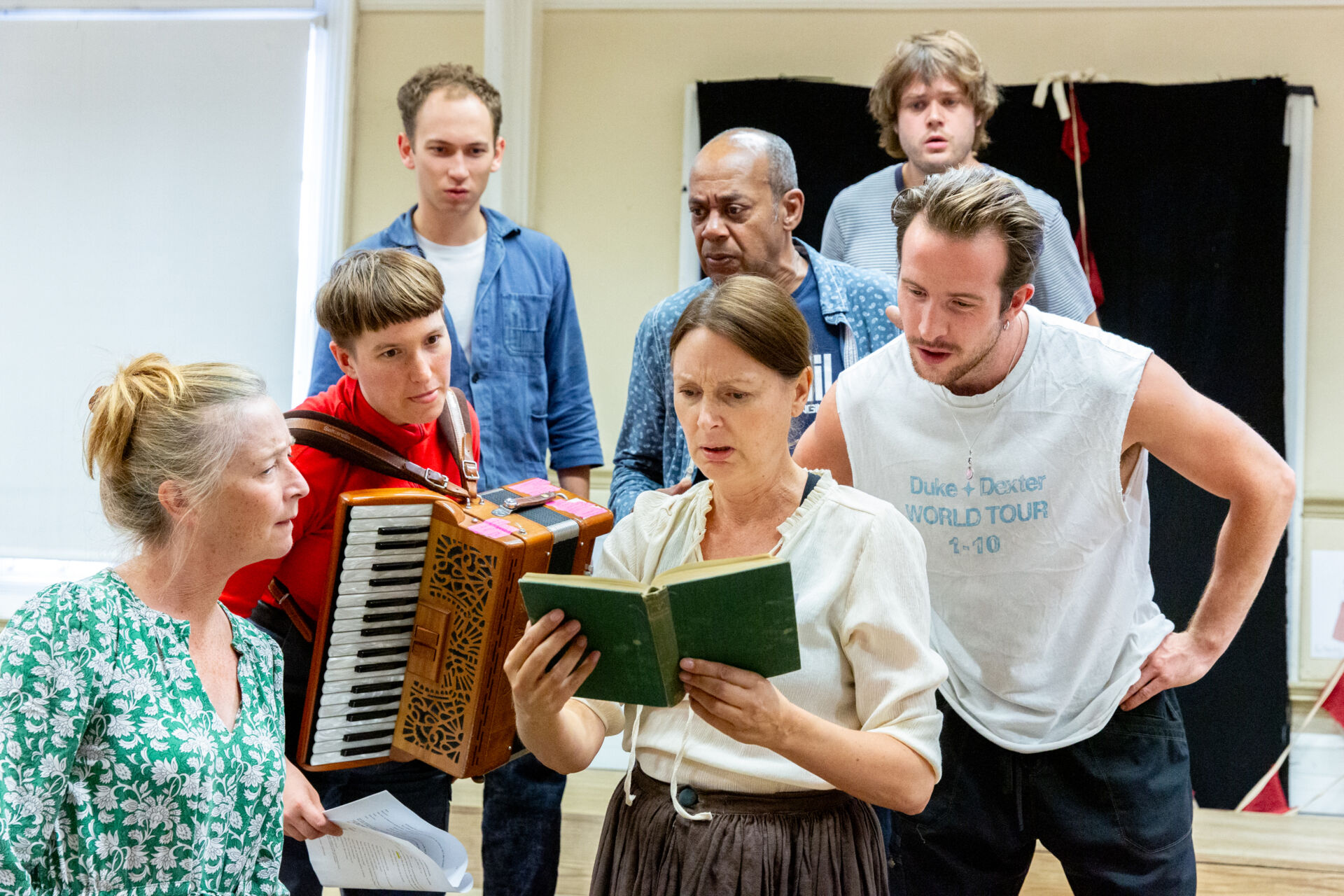
Adapting The Go-Between for stage
An interview with playwright Ben Musgrave and director Jake Smith.
In October 2023, playwright Ben Musgrave approached us about acquiring the rights for a stage adaptation of The Go-Between by L.P. Hartley, whose estate we manage.
You might not be aware that as well as protecting the interests of over 12,000 living writers, we are proud to represent over 50 literary estates in an agency capacity – taking a commission on income – and in some cases we are also the beneficiary of the author’s copyright or royalty income. The work we do for our literary estates makes a significant contribution to our annual income, supporting our day-to-day activities.
With the new adaptation about to tour East Anglia with Eastern Angles Theatre Productions, we caught up with Ben and director Jake Smith to learn more about the journey from securing rights to reaching the stage.
Why The Go-Between?
Ben: Quite simply, I read The Go-Between, fell in love with it, and instinctively felt it was a story that deserved to be told again – particularly here in East Anglia.
It’s an exquisite novel about memory: about looking back at your younger self and discovering something that still has meaning in the present. It’s also a novel that is deeply rooted in this landscape, and that connection between memory and place became central to the adaptation.
Jake: I’m looking for stories with emotional depth that feel relevant to contemporary audiences. At Eastern Angles, we’re particularly interested in work that is rooted in the East of England, whether inspired by its people, landscapes or history. The place isn’t simply a backdrop. It shapes who we are.
I’m also drawn to stories that embrace the theatrical. Theatre should do things that film can’t, inviting audiences to imagine, participate and complete the picture. The Go-Between offered all of that. It’s a timeless love story, but it’s also about memory, class, loss, and the moments that define the rest of our lives.
Securing the rights for an adaptation
Ben: Once I felt the idea had real potential, I spoke informally with a few theatre companies to test whether they thought it was a viable project. Having gained some encouragement, I approached the L. P. Hartley estate through the Society of Authors about acquiring the option for stage rights.
I’d imagined a rather labyrinthine process involving mysterious gatekeepers, but in reality it was extremely professional and constructive throughout.
I acquired the rights personally as a writer rather than through a producing theatre. That involved a significant financial investment for me, but having the rights became the foundation for building the project. I secured Arts Council England funding for an R&D (research and development), and through that Eastern Angles, Norwich Theatre, the Little Theatre Sheringham and St George’s Theatre in Great Yarmouth all became partners for the R&D, with additional support from the University of East Anglia.
Alongside developing the script, we ran workshops and engagement projects across the region, which ended up influencing the adaptation.
Following the success of the R&D, Eastern Angles decided to produce the play, and at that point the production rights transferred to them.
Building collaborative partnerships
Ben: The first step wasn’t actually trying to persuade somebody to produce a fully realised script. It felt more important to develop the script slowly by building a viable show with the right partners, so I was initially both a playwright and a co-producer at the same time. You have to be quite patient. Not everything comes together at once. You put together one piece of the puzzle after another.
If I had one piece of advice, it would be not to wait for somebody else to make your project happen. Find a way to get energy behind the development of the idea, and cast out into the universe for support. Hopefully something will come back.
The theatre industry increasingly understands that this is often how things happen. I enjoy the collaborative side of theatre. Developing this adaptation has reminded me that writing doesn’t have to be a solitary activity. Writers today are often producers, collaborators and advocates for their own work as well as writers. If you genuinely believe in a project, don’t be afraid to begin putting those pieces together yourself.
Jake: This has been a genuinely collaborative process from the outset. Ben didn’t arrive with a finished script. Instead, we spent time exploring what lay at the heart of L.P. Hartley’s novel and how it might become a piece of theatre. Ben received an Arts Council Project Grant, and this gave us time to spend together with actors and begin to shape the adaptation, asking what would resonate with audiences today while remaining faithful to the emotional truth of the story.
One of our biggest ideas was to make the older Leo the storyteller, reliving the defining summer of his life. Rather than presenting the story as a straightforward period drama, we wanted the audience to experience memory itself, fragmented, emotional and sometimes unreliable. Alongside Ben, I worked with the wider creative team to develop the production’s visual language, movement and music, always balancing artistic ambition with the practicalities of creating a show that can tour across the East of England.
The challenges and opportunities of adaptation
Ben: One challenge for me with a much-loved – and well known- period novel is finding a theatrical form that feels joyous and fresh while remaining true to the underlying dramatic energies of the story. We wanted to create space for a playful, deep, intense, sensuous, funny, musical, physical piece of work.
We began asking what Leo’s memory might look like if it was dramatised. This became our chorus – a kind of theatrical representation of Leo’s memory. They challenge him, contradict him, confound him, comfort him.
Quite early in the process we began working with groups of older participants through creative writing workshops, using the novel as a frame. We borrowed the novel’s opening action of Leo opening the old collar box and discovering objects from his childhood. We invited participants to bring treasured objects from their own lives and – as with Leo – those objects proved to be potent portals to the past, and sometimes to vivid reconnection with the people we once were. Each workshop seemed to contain the memories of so many wonderful people, and each group began to feel like it was memory itself. And that really inspired the way the Chorus are now – they sometimes feel a little bit like a creative writing group!
Another really important theatrical decision was to have our 65-year-old Leo play both his 65-year-old and 13-year-old self. It’s been extraordinary watching Howard Saddler (our Leo) inhabit both the sixty-five-year-old and the thirteen-year-old simultaneously. The older Leo is constantly rediscovering, processing and marvelling at the consciousness of his younger self.
When I’m writing an original play, the thing I probably spend most time on is discovering the story itself, coming to terms with its central journey, its shape, its moments of intention and decision and action and change. With an adaptation, the story already exists, and it’s tempting to accept the procession of events as the novel presents them and expect the story to work upon an audience as it does in the novel. But in The Go-Between, so much is seething and shifting beneath the surface – but Leo does not necessarily notice! My job has been to make those hidden forces and actions visible and powerful dramatically, without losing the beguiling sense of mystery.
Creative licence
Ben: As we worked, certain images began to recur, resonate and take on a charge for us. Flight became very important – flight seemed to be a physical equivalent of Leo’s consciousness finding liberation – and finding himself.
I spent time with Hartley’s handwritten manuscript at the John Rylands Library in Manchester and found in that first draft a scene in which Ted teaches Leo how to swim. It struck me as one of the moments of greatest freedom and liberation for Leo in the entire story – he learns to ‘fly’ through the water and, in doing so, passes into a new region of being.
Hartley eventually crossed this scene out (though it still exists in the appendix of the most recent Penguin edition). I don’t know why Hartley removed the scene; perhaps it felt a little too exposing for him. But I wanted Leo to find that deep moment of transformation and joy in the water. This is probably the moment that feels like I’m taking creative licence, but I’d like to think it’s in keeping with the spirit of what Hartley was exploring.
From script to production
Jake: We begin by asking what the story needs emotionally, then those ideas grow through conversations with the designer, composer, actors, and production team.
As director, my role is to bring those elements together into one shared language, ensuring the design, movement, music, costumes and performances are all telling the same story. It’s a hugely collaborative process. The best ideas often emerge in the rehearsal room, where everyone contributes creatively. Theatre is never built by one person. It’s built by a company of artists working towards a common vision.
I don’t think a play is ever truly finished. A script reaches a point where it’s ready for rehearsal, but that’s really where another stage of its life begins. Actors discover new rhythms; music reshapes scenes, and physical storytelling reveals things that simply aren’t visible on the page.
Ben has been an integral part of that process, remaining open to discoveries throughout rehearsals. Once the production opens, the script naturally belongs to the company and its audiences, but theatre is always evolving. Every performance is slightly different because every audience brings something unique to it.
That’s one of the reasons I love directing. Theatre is a living art form. Every night the story is rediscovered, and every audience helps complete it.
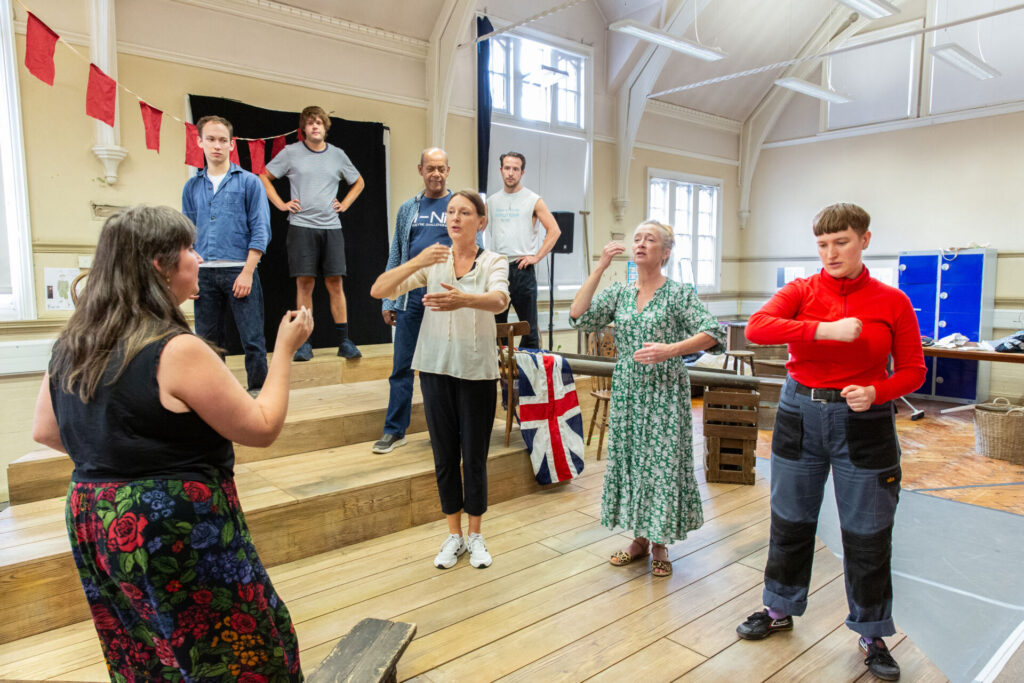
The Go-Between is touring East Anglia from 13 August to 19 September 2026. Book your tickets here
Find out more about the literary estates we manage and acquiring rights.
Join our Scriptwriters Group.