
The announcement came in the long-awaited Ministerial Statement and Report on Copyright and Artificial Intelligence, published today. This stated that “in light of the strong views from the consultation, the gaps in evidence and the rapidly evolving AI sector and international context, a broad copyright exception with opt-out is no longer the government’s preferred way forward”.
Organisations across the creative industries, including the Society of Authors (SoA), strongly opposed the opt-out approach and took part in the Make it Fair Campaign which achieved large scale support.
The SoA also held a protest at Meta HQ last year about the unfair use of pirated books to train their AI model. We partnered on the Brave New World? Report and gave evidence at the Lords Committee. Last week at the London Book Fair we supported the Don’t Steal This Book campaign, and launched our Human Authored labelling scheme for authors.
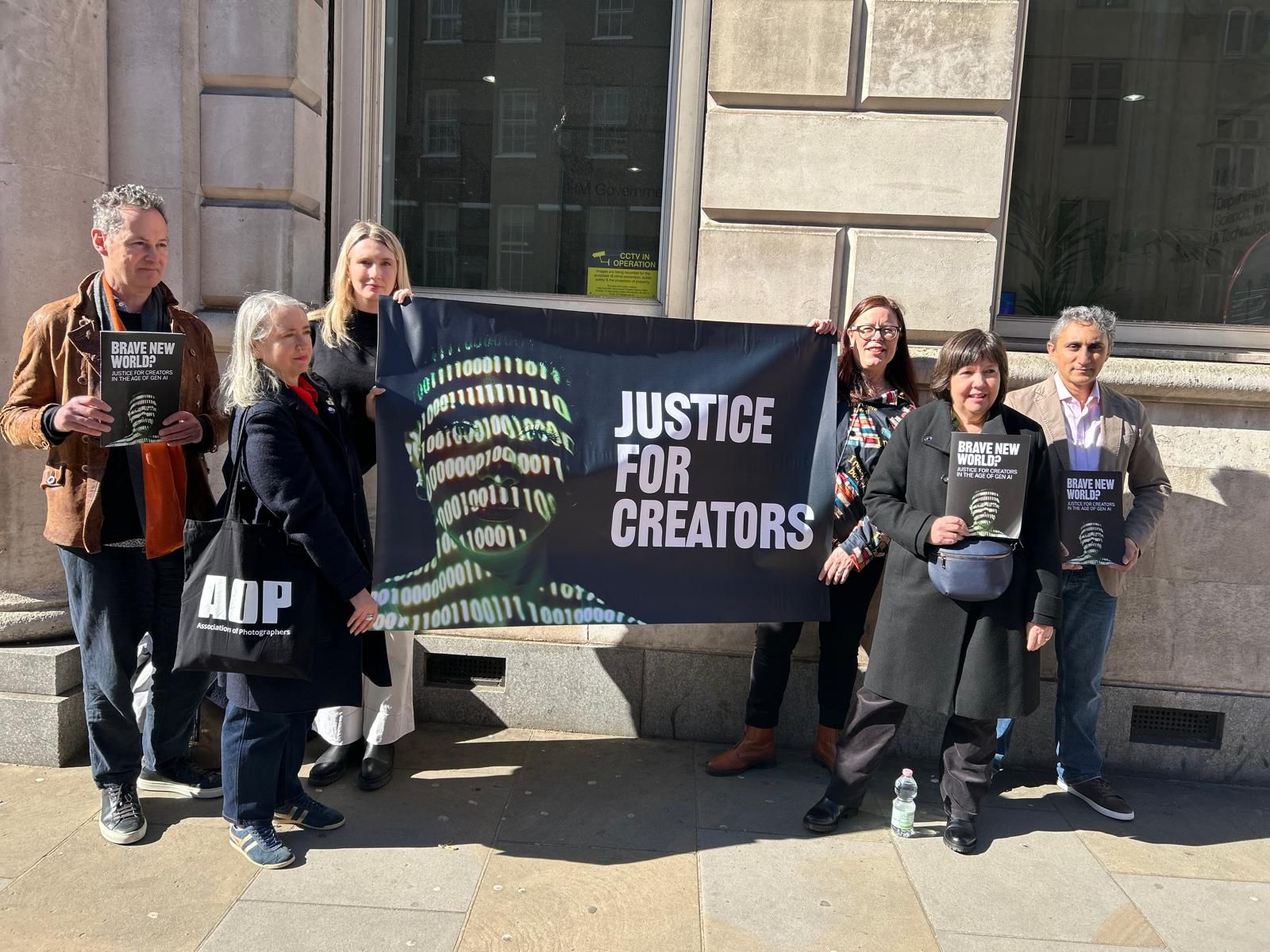
This morning, in preparation for the announcement, we gathered outside the offices of the Department for Science, Innovation and Technology with other creative industries to continue making our voices heard.
Although a welcome step in the right direction, today’s news does not mark a full stop in our campaigning. There are still huge levels of uncertainty that threaten livelihoods when authors’ copyright-protected work continues to be used without permission.
Responding to the report, the SoA’s Chief Executive, Anna Ganley, said:
“Today marks a hard-won moment for authors and creators, as changes to copyright that would have weakened protections are finally laid to rest.
“We welcome the Government’s reassurance that the option of a TDM (text and data mining) exception and opt-out published back in 2024 are now officially off the table.
“The commitment to a four-strand work programme looking at Digital Replicas, AI Labelling, Creator Control and Transparency, and a working group for Independent Creatives all have the potential to support policies the SoA have been campaigning for to strengthen protection and control.
“However, these wins have been a long time coming. We petitioned the government a year ago asking for justice for authors. The pace of progress needs to match the excessive speed at which AI is developing and encroaching on creative industries. Each day that the uncertainly continues is a risk to author incomes. Failure to act without further delay will unquestionably have a catastrophic and irreversible impact on all UK authors.”
The consultation report also revealed strong, cross-sector backing for statutory transparency measures that would oblige AI developers to disclose what material has been used in training, helping creators license their work effectively. We will continue to advocate for copyright protection which includes full transparency on how authors work is used, the right to choose if it’s included, and fair compensation when it is.
The government has set out four key areas where it will focus the next phase of its work:
- Digital replicas – the government will launch a consultation in the summer to seek views on addressing harms caused when someone’s likeness is replicated without their permission, while protecting legitimate innovation.
- Labelling AI-generated content – the government acknowledges the value of labelling to help consumers understand whether content has been made using AI, and to protect against disinformation and harmful deepfakes. It will establish a taskforce to put forward proposals for government on best practice for labelling AI-generated content, with an interim report to be published in autumn.
- Creator control and transparency – the government will publish a review of the mechanisms available for creators to control their works online. This will include standards, technical solutions and best practice on input transparency. This review will inform where there are gaps and whether there is an appropriate role for government in addressing them.
- Independent creatives – the government will launch a working group on independent and smaller creative organisations to explore whether there is a role for government to support their ability to license their content.
We will only know when the four work programmes are up and running if they deliver real protections: control, consent, and payment for every creator. The SoA welcomes this renewed opportunity to work with government to achieve this goal.
Thank you to all of our members for helping us to campaign on this important issue.